Took a trip down to Margate today to see the Eastern Black Redstart (ssp Phoenicuroides which has characteristic orangey-red underparts), which irrespective of the potential of a prospective future split, was just a really stunning bird to see. Present for its third day, it seemed quite at home happily feeding on the beach and cliffs only a few feet away from its small crowd of admirers, and presented some suberb photo opportunities.
Sunday, 13 November 2011
Friday, 11 November 2011
Geese Galore
Today was notable for a number of flocks of Geese going over the patch, with the highlight being a group consisting of 2 Tundra Bean Geese and 9 Whitefronts which pitched down in a field at Northrepps, with the former species being only my second record for the patch.
The 2 Beans only stayed in the flock for a short while so only a distant record shot of them was obtained, but the Whitefronts seemed quite settled allowing better pics to be taken.
A number of other flocks of grey geese were noted going over, including a flock of 14 Greylags and 2 Whitefronts which came in-off the sea, with the origins of the former being intriguing.
A visit to Trimingham produced only a single Chiffchaff, and checks around other areas of the patch produced little of note in the cold and blustery conditions.
Thursday, 10 November 2011
Hume's Yellow-browed Warbler
After yesterdays events, naturally Trimingham was the obvious destination of the day with the hope that the Hume's Yellow-browed Warbler would still be present, although after about an hour of searching it wasn't looking good, but a showy Firecrest definitely brightened up the gloomy morning.
However eventually a couple located a yellow-browed type and upon calling us over and seeing it up in the canopy it quickly became evident that this was undoubtedly going to be the Hume's, and after a brief disappearance it popped up again right infront of us and conviniently called too to confirm its id. It continued to be mobile and elusive until we sussed out where it had settled down to feed and was then treated to good views on and off during the next hour or so. So a great relief that it had stayed overnight and an excellent new bird for the patch list too.
A couple of Chiffchaffs and Blackcaps were also present in the scrub, along with a Bullfinch and a few Golden Plover were noted flying over.
Wednesday, 9 November 2011
Pallas's Warbler etc
Another excellent day on the patch today started with a walk along the clifftop between Sidestrand and Trimingham. A flock of 16 Waxwings flying east got the day going, closely followed by a Peregrine cruising the cliffs. Redpolls and Siskins were flying overhead, as did a Snow Bunting, plus various thrushes and Meadow Pipits.
As I walked along the Peregrine landed on the cliffs in the distance but soon after what I initially presumed was the same bird suddenly flushed from a much closer position than I thought it was, and I watched as it headed out over the sea. I then scanned further along and saw that the original bird was still further ahead so infact there were two and a great double for the patch.
Walking further along 14 Whitefronts came in-off and then joined up with a massive flock of Pinkfeet that were heading westwards slightly inland, and 9+ mobile Snow Buntings were on the cliffs/ clifftop stubble field.
Then came the real surprise of the day when a bird was flushed from the cliffs and bounded along infront of me before landing again. Initially it just didn't register what it was but on raising my bins I was shocked to see that it was a Little Owl. It sat momentarily on an outcrop before quickly flying again and disappeared into a hole in the cliff-face! Quite what it was doing here I don't know, and as to whether it was an incoming bird or a resident bird from somewhere inland is anyones guess.
I then got a call to say a potential Hume's Yellow-browed Warbler was at Trimingham so I quickly made my way there, but unfortunately it couldn't be relocated although a Hume's-like call was heard in the trees. However things suddenly took a turn for the better when a Pallas's Warbler appeared in the same area and eventually treated us to excellent views just above our heads. In fact at one point there was the Pallas's, a couple of Chiffchaffs, Blackcap and 1+Yellow-browed Warblers all in the same group of trees at the same time so it was hard to know which way to look! Further searching couldn't turn up the Hume's, but as an added bonus 2 Whooper Swans flew in-off and headed inland, my first of the year.
A late afternoon check along the beach for rare Wheatears drew a blank, but with the Hume's being reported again at dusk hopefully it'll stick overnight, especially as I missed the only other one to be seen on the patch due to being on Fair Isle at the time.
Tuesday, 8 November 2011
Great Grey Shrike and more
With the news that a Great Grey Shrike had been seen in East Runton, near to Cromer Waterworks, this was naturally my first port of call today and on arriving on site it was immediately seen briefly perched up before dropping out of sight.
Frustratingly it then decided to lie low for nearly the next two hours, during which time my first Waxwings(6) of the winter flew over heading south, and good numbers of Blackbirds, Redwings and Fieldfares passed over too.
Eventually it reappeared right in front of us virtually exactly where it had dropped down, and proceeded to show well, but being alongside the railway, each train that passed flushed it, but after a bit of a fly round it soon returned to the waterworks compound and occasionally came right onto the railway embankment performing admirably for us.
With the nights now closing in and it being such a dreary day into the bargain, I then did a whistle-stop raid on a few of the clifftop sycamore woods on the patch in the remaining daylight with the hope of finding a Pallas's Warbler. No such luck but I came close with the discovery of a Yellow-browed Warbler at Sidestrand which I was still more than happy with as it had looked like this was going to be the first autumn for quite a while that I hadn't self-found one on the patch. So an excellent ending to a great day on the patch and although the autumn is now fast coming to an end, hopefully with one last blast of effort over the next few days there may still be that one more decent bird to be found.
Monday, 7 November 2011
A few more Little Auks
After yesterdays variety, seawatching today was a bit of a let down with the number of birds on the move vastly reduced, with most notably a virtual absence of any wildfowl moving.
I still managed c6 Little Auks, with 4 singles on the sea by the pier at various points during the day, and a couple more whizzing through in the afternoon. A handful of Red-breasted Mergansers, Goldeneye and Eider were noted passing by along with a couple of flocks of Wigeon and Brents but that was about it on the wildfowl front.
A lot of Gulls were feeding close in just beyond the breakers with a good number of Kittiwakes amongst them, along with a single Little Gull, Shag, a few Guillemots and a Red-throated Diver, but sadly the flock failed to drag in anything better.
A break from seawatching during the middle of the day produced a Snow Bunting along the cliffs by the lighthouse and revealed that good numbers of Blackbirds had come in, but not surprisingly with the coast being battered by the wind little else was noted.
Sunday, 6 November 2011
Seawatching
With a good northerly blow, a seawatch was definitely the order of the day today and during the six hours of observation an excellent variety of species were noted.
Patchwise, the undoubted highlight was 3 Avocets which flew west, with my only previous record on the patch being back in 2005 when a pair were seen passing on two consecutive days in late March. Other patch year ticks seen were a single Little Auk which flew west close in with 4 Dunlin, a Long-tailed Duck and a Pomarine Skua which was seen to take what was probably an auk off the water.
Others notable species seen included a Grey Phalarope which was watched feeding on the sea amongst a flock of gulls, 3 Bonxies, a few Little Gulls and Kittiwakes, an Arctic Tern and a Woodcock in-off.
Last but not least, good numbers of wildfowl were also on the move with Shelduck and Wigeon being the most abundant species, plus lesser numbers of Teal, Pintail, Common Scoter, Red-breasted Mergansers, Goldeneye, Eider, Mallard, Gadwall, Shoveler, Pochard, Tufted Ducks, Scaup and Brent Geese were all noted and kept the interest up throughout.
Saturday, 5 November 2011
Early November
As is usual at this time of year Shags have started to appear offshore, but this year has seen higher than usual numbers of them both passing by and lingering on the sea. Quite a lot of them have been in pairs and are presumably siblings staying together, although a few singles have also been noted too such as this one on the groynes at West Runton.
The first returning Snow Buntings of the winter have started to pass through with a single west past Overstrand and three on the beach at West Runton, with one of them pictured below.
A few more Redwings and Song Thrushes have been noted coming in-off, along with several Starling flocks and a Woodcock, and the Tawny Owl that was first noted a couple of weeks back in Warren Wood continues to stay faithful to its roosting site although its always mostly obscured buried deep in the ivy. On the sea a nice flock of Eider were noted passing by along with a few Kittiwakes, and the usual Guillemots and Red-throated Divers were lingering offshore.
The first Stonechat that I've seen on the patch since the spring was noted at West Runton, where the usual wintering Med Gull continues to delight.
Monday, 31 October 2011
A Swift end to the month
Wednesday 26th saw me doing my usual check of the patch and having done the lighthouse area with little reward I decided to check out East Runton which I'd somewhat neglected over the last few days. The usual area was equally birdless so I decided to have a quick check of the clifftop paddock at Wyndham Park, but as it only held the local House Sparrows and a couple of Robins I was about to retrace my steps when I looked up to see a swift sp powering towards me seemingly having just come in-off the sea.
Mindful of the late date and the southerly airflow that we are currently enjoying, the possibility that it could be a Pallid naturally sprung to mind. It quickly passed overhead and then headed south over the coast road before veering east and headed off low over the houses on the west side of Cromer and out of sight. Views were frustratingly brief but its extensive pale throat, overall paleness of plumage and contrast in the flight feathers all pointed to it indeed having the potential to be a Pallid, so I set off to try to relocate it.
A five minute scan over Cromer drew a blank so I quickly went up to the lighthouse to check the cliffs there as in the past they have been particularly attractive to vagrant swifts with both Little and Alpine Swifts there previously. There was no sign but I bumped into Ian P up there and after a while of chatting and scanning he picked it up distantly back over the same area I had originally found it, so annoyingly it had probably not gone very far afterall.
We quickly raced back to Cromer and were able to watch it briefly before it headed off west, with these views further adding to the probability that this was indeed a Pallid Swift. I subsequently saw it briefly from Beeston Regis Church, and by this time other observers also caught up with it here and were confident that it was a Pallid too.
Thursday morning saw me back at Beeston Church and after a short while of scanning I picked up presumably the same bird feeding happily over Sheringham town. With the news quickly broadcast a good number of birders were able to watch it as it continued to linger till c11.30 before it drifted off east whereby I relocated it as it fed over West Runton for a short while.
Subsequently I picked up what may have been a different swift feeding way inland over the ridge at Sheringwood before it headed off further inland and was lost to view, and then an hour later a swift appeared briefly over Beeston Church before quickly heading west along the coast and disappeared off over Sheringham. Now whether this was the same bird doing a big loop, or whether two or even three birds were involved in these sightings I'm not sure.
After a gap of three days, another swift was seen over Cromer this morning, so I set about the task of relocating it and eventually managed to refind it feeding over West Runton where it lingered distantly for c20 mins before being lost to view. Presumably the same bird was then picked up over Sheringham where it remained for the rest of the day in the company of a Swallow or two, and as the day drew to a close a second swift joined them before they were all lost to view as dusk approached. With todays original bird seemingly continually changing appearance depending on the light and angle of viewing it was a real nightmare to clinch and what is evident is that autumn swifts are far from easy id's without prolonged and good close-up views and ideally they're photographed too.
Thankfully others managed to get some fairly decent photos of some of the birds involved this week, but with my point & shoot all I could manage is the one below of the first of the two over Sheringham today.
Tuesday, 25 October 2011
Late Sand Martin
Highlight of the last few days around the patch was a Sand Martin seen by the lighthouse on Saturday 22nd, which I think is latest date I have ever seen one locally so a good record.
My first Woodcock of the autumn was flushed off the clifftop along the golfcourse also on Saturday, although few other migrants have been noted recently apart from numerous flocks of Starlings coming in-off, and a few Redpolls continue to pass through each day.
Offshore good numbers of Little Gulls have been noted lingering, with good numbers of Kittiwakes and a few Arctic and Common Terns also joining these feeding flocks. A few Shags have started to appear offshore, along with Guillemots and Razorbills, and a single Bonxie was also seen passing by.
Thursday, 20 October 2011
Grey Phalaropes
The last few days have been fairly quiet migrant wise, although a few flocks of Siskins have been noted still moving through.
A seawatch yesterday evening produced a Balearic Shearwater going west, along with a few Gannets, Kittiwakes and Auks.
Although I've been checking each day, no further sign has been had of the Willow Emerald Damselfly, although whilst checking today in sunnier and calmer conditions a good number of Common Darters were evident and a Rock Pipit was busily feeding around the edges of the reservoir as it has pretty low water levels in it at present.
A quick glance at the sea off Overstrand showed that there was the odd Diver and Gannet moving so I thought it was worth a bit more of a serious look, so I returned with my scope just in case. After a while of seeing a few more Gannets and auks, including a fairly close Razorbill, I picked up 3 smallish birds flying fast right a fair way out through my bins so I quickly grabbed my scope just in case they were Little Auks as a few had started to be seen now. I quickly got on to them and saw that they were infact waders, but given the distance they were away I was just about to take my eyes off them when they stalled and landed on the sea! They quickly got up and carried on east and although I was naturally thinking Phalaropes, I was also thinking would Sanderlings pitch down momentarily like that?
Anyway after a short distance they again landed on the sea and were obviously surface feeding before again flying and pitching down again to feed, and slowly coming slightly nearer in the process. By now it was evident that they were indeed Grey Phalaropes and the more you watched them feeding and then flying around before landing again, the typical jizz of a phalarope, both in flight and on the sea, was very evident despite them being over half way out.
They remained offshore for about two hours in total, occasionally splitting up, but constantly feeding then flying round a bit in search of food and then pitching back down again when they presumably found some. Fortunately given their prolonged stay a few locals sucessfully connected, before they eventually drifted fast away on the current and then flew purposefully west as daylight was closing in.
So an excellent patch record, especially with three together, and great that they hung around happily feeding out to sea, which is something that I have never seen before.
In addition to the Phalaropes, a single Manx Shearwater was noted heading east and a female Goldeneye, my first of the year, was seen heading west.
Sunday, 16 October 2011
Willow Emerald Damselfly
A fairly quiet day on the patch today birdwise failing to find my own Yellow-browed Warbler, and failing to see two others that had been seen locally too. The only highlight being a Tawny Owl found roosting in an ivy covered tree in Warren Wood as it hooted loudly as I was passing.
However the day was more than salvaged when up by the reservoir I flushed an emerald damselfly from the grass in front of me. Fourtunately it only flew a metre or so, so I quickly set about the task of trying to id it as there was a good chance it was one of the rarer species. A check of the pterostigma ruled out Southern (which has a bi-coloured one), so the next thought was that it could be a Willow. It was proving hard to stand far enough back to focus my bins on it but at the same time make out the detail on the thorax so I decided the best course of action was to get a photo and blow up the picture on the monitor to check its appearance.
Luckily it allowed close enough approach for a decent pic and checking the results did to my delight show that it had the prominent side spur on the thorax typical of Willow Emerald Damselfly. I took a few more pics and then quickly made a phone call to get others to the site and stood well back to avoid disturbing it. However frustratingly, more so for them, as they were in sight it flew again but this time was caught up in the blustery wind and was swept away out of view and could not be found again despite searching.
With this to my knowledge being the most northerly record so far in the UK, and only the third site in the county where they have been recorded, this was an excellent record, and a Norfolk tick for me. One can only speculate as to its origins, presumably it had just arrived from the continent during the recent (south)easterlies rather than it being one moving north from Suffolk where they have recently colonised, although I guess it could have been around for a while undetected.
So a great find that I was really pleased with, and also delighted that the photos hastily taken came out pretty well too showing both the side spur on the thorax and the black-bordered orangy-brown pterostigma well to confirm its id.
Saturday, 15 October 2011
East Hills
A dawn visit back to Warham Greens this morning proved fruitless as the Rufous-tailed Robin had moved on overnight, but it was nice to see a few familiar faces from around the country. Whilst checking the coastal bushes a couple of Crossbills flew over and a Corn Bunting, and a ringtail Hen Harrier was noted on the saltmarsh.
With yesterdays initial news that the robin was on East Hills, I was only thinking last night that I should really know how to get out there should there be a major bird found there in the future and as luck would have it, whilst walking back with Eddie and Penny to our cars which were in the Stiffkey campsite car park they said they were going out later when the tide had dropped and said I was welcome to join them.
Now its been said before by others elsewhere, but its definitely worth repeating, do not attempt to go out there alone if you don't know the way, as with various creeks to cross and very soft sand in places the crossing is dangerous if you don't know the correct route to follow, and is still hazardous even when you do, and its easy to get lost especially on the way back, when you could potentially get cut off by the incoming tide.
Anyway the long walk out was brightened up with a couple of Lapland Buntings on the saltmarsh, but the hills themselves were pretty quiet with just a few thrushes and the odd Blackcap and Chiffchaff seen, along with a Short-eared Owl in the dunes, but nevertheless it was mission accomplished in regards to knowing how to get out there, so thanks to my guides, just hope I can still remember come next year!
Friday, 14 October 2011
RUFOUS-TAILED ROBIN
Despite an initial movement, there were fewer birds on the move today, but still nice numbers of Thrushes and Finches etc were seen going through/coming in-off, with additional species to those noted yesterday including a few Mistle Thrushes, Grey Wagtail and a Great Spotted Woodpecker.
At least one Short-eared Owl was seen to come ashore and a flock of 9 Crossbills flew east. Grounded birds were slightly better than yesterday with single Chiffchaff, Blackcap and Wheatear noted, along with a few more Goldcrests and Robins, plus a frustrating sighting of a bright phyllosc which came in-off but it bush-hopped quickly inland before I could get anything on it.
With the warm and sunny weather there were still a number of Butterflies and Dragonflies around, with this Migrant Hawker being the most co-operative for photos.
Despite a lot of searching and the high hopes of finding something good, the day appeared to be going out on a whimper, until of course just after 5pm the pager announced that there was a Rufous-tailed Robin on East Hills nr Wells! Even though I knew that even if the tides would allow access there was little chance of actually getting out there before the light went, I still just leapt into my car and made haste westwards. En route a series of confusing messages were broadcast whereby it transpired that the bird wasn't on East Hills at all, or on the saltmarsh, but was actually on Warham Greens - obviously somewhere where I could get to before dark!
So after a bit more confusion/panic after arrival as to exactly where the bird was, managing to run past the crowd in the process, I eventually found the correct spot and after an anxious wait I spotted the bird fly out of the tree it had earlier disappeared into and then watched it as it moved two or three times further from tree to tree along the access track before loosing it from view. So far from brilliant views, but views nonetheless, and a total relief to have connected given all the earlier confusion and considering I thought I had no chance of even getting near it when I left home.
Thursday, 13 October 2011
Yellow-browed Warbler and good vis mig
As expected there were good numbers of birds both moving along the coast and coming in off the sea today.
Best bird of a mornings searching round the patch was a Ring Ouzel over the golf course, whilst good numbers of Redwings, Fieldfares, Song Thrushes and Blackbirds were all coming in in flocks of various sizes. Finches were also well represented with Brambling, Siskin, Redpoll, Greenfinch, Goldfinch, Chaffinch and Linnet all noted in varying numbers, along with a flock of Crossbills which were heard but not seen.
Meadow and Rock Pipits continued to be on the move, and other species noted flying through/coming in-off included Reed Buntings, Grey Herons, Pied Wagtails, Skylarks, Starlings and a single Swallow.
News of a Yellow-browed Warbler at Northrepps was too good to ignore and after a short wait and a bout of 'pishing' it appeared right in front of me and as ever was a real delight to see and being over 2km from the coast it was a notable inland record for the patch too. A finch flock there was noted to contain several Bramblings, and as the day progressed more small flocks were encountered along the coast.
A bash round Trimingham produced the highlight of a couple of Short-eared Owls in-off, which were part of a major arrival of the species into the county today, the second of which landed briefly on the cliff-face, and then as the day closed in, a check of East Runton produced little extra of note apart from more Thrushes moving inland.
So an excellent day of overhead migration but this sharply contrasted with the complete lack of migrants on the deck, apart from a few Robins and Goldcrests which may have predominantly been local birds anyway, but hopefully with southeasterlies forecast throughout tomorrow, more continued effort of searching will pay dividends.
Wednesday, 12 October 2011
Hen Harrier and a few more migrants
A walk around the lighthouse area Sunday was rewarded with a ringtail Hen Harrier which appeared to be chasing something (potentially an incoming migrant) over the cliff top before being lost to view.
A large Pipit, probably Richards, was noted heading west amongst the continued passage of Meadow and Rock Pipits and a number of Skylarks were also noted coming in-off.
The continual rain today made searching for migrants a thankless task, but a mixed flock of c50 Thrushes in-off by the lighthouse showed that birds were arriving and hopefully with a dry day and continued easterlies, hopes are high for a decent days birding around the patch tomorrow.
Saturday, 8 October 2011
More action on the sea
With fairly strong northwesterlies blowing, attention over the last couple of days has turned to a bit of seawatching with this morning being the best of the two producing some hoped-for patch year ticks.
Wildfowl were the most abundant species with quite a few Pintail, c10 Red-breasted Mergansers, Shoveler and Scaup all being new for the year, along with a good supporting cast of Tufted Ducks, Wigeon, Teal, Gadwall, Mallards, Common Scoter, Brent and Pink-Feet.
Single Sooty and Manx Shearwaters were seen heading west along with a few Bonxies, and also c15 Skuas were seen way out with most casually soaring east high along the horizon which I'm happy to leave as skua sp's, although another nearby watchpoint apparently put these down as Poms.
A good passage of Gannets were also heading west, with a few Kittiwakes, Razorbills and Guillemots and Red-throated Divers also on the move. Waders were also passing, most notably half a dozen or so Snipe, along with Dunlin, Curlew, Bar-tailed Godwit, Grey Plover and Oystercatcher.
A number of small passerines, mostly Pipits were noted flying west too, some far out to sea but some overhead too, of which some were Rock Pipits.
This evening the pager alerted me to the fact that a Long-tailed Skua was lingering off Cromer so I quickly hastened my way there, but it unfortunately flew west just as I was arriving so I decided to try to get in front of it and quickly carried on to West Runton. After a while of scanning the sea I picked up presumably the same bird*close inshore and watched as it passed by and in turn scattered a large roosting flock of mainly Black-headed Gulls off the sea before potentially going back down on to the sea presumably to roost as the light was fast going at this point.
The usual Med Gull was in the car park on its favourite post, and a few Rock Pipits were down on the beach feeding on washed up seaweed.
*Having subsequently looked at the photos of the Cromer bird it would appear that this was a different individual.
Wildfowl were the most abundant species with quite a few Pintail, c10 Red-breasted Mergansers, Shoveler and Scaup all being new for the year, along with a good supporting cast of Tufted Ducks, Wigeon, Teal, Gadwall, Mallards, Common Scoter, Brent and Pink-Feet.
Single Sooty and Manx Shearwaters were seen heading west along with a few Bonxies, and also c15 Skuas were seen way out with most casually soaring east high along the horizon which I'm happy to leave as skua sp's, although another nearby watchpoint apparently put these down as Poms.
A good passage of Gannets were also heading west, with a few Kittiwakes, Razorbills and Guillemots and Red-throated Divers also on the move. Waders were also passing, most notably half a dozen or so Snipe, along with Dunlin, Curlew, Bar-tailed Godwit, Grey Plover and Oystercatcher.
A number of small passerines, mostly Pipits were noted flying west too, some far out to sea but some overhead too, of which some were Rock Pipits.
This evening the pager alerted me to the fact that a Long-tailed Skua was lingering off Cromer so I quickly hastened my way there, but it unfortunately flew west just as I was arriving so I decided to try to get in front of it and quickly carried on to West Runton. After a while of scanning the sea I picked up presumably the same bird*close inshore and watched as it passed by and in turn scattered a large roosting flock of mainly Black-headed Gulls off the sea before potentially going back down on to the sea presumably to roost as the light was fast going at this point.
The usual Med Gull was in the car park on its favourite post, and a few Rock Pipits were down on the beach feeding on washed up seaweed.
*Having subsequently looked at the photos of the Cromer bird it would appear that this was a different individual.
Thursday, 6 October 2011
Early October
With unusually high temperatures at the start of the month, October has seen little change birdwise although a few Divers lingering offshore from the patch have provided a nice distraction from flogging empty bushes.
With the Sandhill Crane continuing to linger at Boyton, and my Dad not having made the trip up to Orkney with me to see the last one, we took the opportunity to go and see it today, and although it was sadly far too distant for any worthwhile photos, it was still nice to see another one anyway, just a shame it chose not to linger in Norfolk instead.
Friday, 30 September 2011
Late September round-up
The remainder of the month has continued to be very slow going on the patch migrant wise with the persistent westerlies not giving way until the last few days with some SSE winds resulting in a bit of movement.
Best birds seen included a Pied Fly in Warren Wood, a Short-eared Owl in-off the sea there too, and a few Whinchats and Wheatears were incoming along the golf course.
A Grey Wagtail in my driveway was a nice house tick, and other birds noted on the move through the patch have included a Marsh Harrier in-off, the first Pinkfeet of the autumn, and vis-mig along the GC producing a few Redpolls and Siskins, Yellowhammer, the first House Sparrows that I can ever recall seeing along there, Lapwings, Meadow Pipits, Skylarks and Starlings, but the most notable were these 13 Grey Herons which came in high from the NE and then headed off west along the coast.
Off the patch a walk up the point yielded a Yellow-browed Warbler and a Redstart in the plantation showing that there were undoubtedly a few more things waiting to be found, but sadly this period will ultimately be remembered for the two 'Long-toed Stint' depressing fiascos and which brought the day that I happily phase that much closer.
Saturday, 17 September 2011
Seawatching and a few migrants
With the steady stream of westerlies over the last couple of weeks migration has been pretty slow with just the odd Wheatear, Whinchat, Lesser Whitethroat and Blackcap seen round the patch.
Other notable records have included a few Swifts continuing to move through, a Hobby over East Runton, Dunlin and Common Sand on the reservoir, and a Med Gull feeding offshore from Overstrand.
Despite the 'wrong' winds, most action however has been on the sea with the highlights being a good evening passage of Manx Shearwaters on Tuesday, my first Sooty Shearwater of the year on Wednesday morning, and on Friday two more year ticks with a nice adult Black Tern and 2+ Balearic Shearwaters with one close in bird giving excellent views, and another which was watched lingering around one of the small crab pot boats offshore amongst the melee of gulls feeding on the discarded food being thrown overboard.
The first Brent Geese of the autumn were also noted along with Red-throated Divers, Common Scoter, Teal and Wigeon also on the move. Other birds noted passing by included Arctic and Great Skuas, Fulmars, Kittiwakes, a few auks and lots of Gannets.
Sunday, 4 September 2011
Early September
The first few days of the month have been pretty quiet around the patch with the only notable sightings being the first Wheatear of the autumn on Cromer GC, a nice summer-plumaged Red-throated Diver close inshore off Overstrand along with a good count of 52 Cormorants on the beach, and the very noteworthy local sight of a Marsh Harrier quartering fields towards Northrepps.
Monday, 29 August 2011
Seawatching
Final action of the month was a bit of seawatching both yesterday evening and this morning with highlights being a handful of Manx Shearwaters and Arctic Skuas plus a single Bonxie.
A bit more time was spent in Warren Wood but no further sightings of either the Greenish or Bonelli's were had over the two days, with the lookalike Chiffchaff continuing to cause confusion with the latter on at least one occasion whilst I was there.
Saturday, 27 August 2011
Bonelli's Warbler and Burrowing Owl!
Once the rain had stopped, during which time I was having a rather uneventful seawatch, yesterday afternoon was again spent in Warren Wood where the Greenish Warbler occasionally performed, and was again heard both calling and singing. Unfortunately only UTV's were had of what may have been the reported Bonellis Warbler, but 10+ Swifts were a notable distraction during the searching as they have left very early this year and these were the first I had seen, barring a single bird, in the last 3 weeks.
So today was once again spent in Warren Wood, but with no reports of either warbler, and news that a Burrowing Owl was at East Runton I left to see that as although it was an escapee from the local zoo, being on the patch it was a worthwhile distraction from starring at leaves all day again.
Of course soon after arriving at the Owl which was performing well, news came through that the Bonelli's was being watched. So after a tortuous drive back through Cromer town centre and the many holidaymakers, I arrived back at the wood where only a bonelli's lookalike Chiffchaff was seemingly being ticked by the assembled crowd, the real one presumably having already disappeared.
A further hour and a half later the real Bonelli's was relocated by the old coastguards lookout and after a few tantalising half views of it from the clifftop, a quick change of position to inside the wood produced excellent close views of it as it fed in a holm oak and naturally I was elated to have finally connected with it.
The Greenish Warbler was also still present today, but only poor views of it were had this time as it was keeping high in the tops of the trees in the centre of the wood, with in reality only its call giving away its id. Other birds seen included a Hobby in off the sea, an Arctic Skua past close inshore and the Swifts and other hirundines still feeding over the woods.
I then returned to East Runton where the Burrowing Owl was still performing well having apparently earlier evaded capture from zoo staff. Both it and its mate had burrowed (what else!) out of their cage but whilst the other one had stayed around the zoo grounds, this one had decided to seek pastures new and what better than a caravan park on the coast!
Thursday, 25 August 2011
GREENISH WARBLER
After a check round East Runton drew a blank on the migrant front, I then moved on to the lighthouse area and whilst taking my usual route through Warren Wood my attention was grabbed by a series of loud disyllabic calls, very akin to that given by a Pied Wagtail, coming from an area of trees just in front, and although I was initially puzzled by the call, an educated guess was that it may well be a Greenish Warbler given that there had been 3 others reported along the coast over the last couple of days.
Although the calls quickly stopped I guessed they had been eminating from a holm oak on a high point above so I carefully made my way up the slope and under the tree hoping that it was still in there. After a few seconds I glimpsed a movement above me and quickly ascertained that it was indeed a warbler and then with brief tantilising views through the foliage started to note its appearance - nice clean white underparts, pink lower mandible and a fairly strong supercilium. Frustratingly I was only getting it from underneath so I was actively willing it to give me a decent view of the wings, and after what seemed like an age it finally obliged to reveal to my delight a wing-bar and fully confirmed my suspicions as to its id.
I quickly phoned my Dad and another local who were both on site within minutes, and although I'd temporarily lost sight of it whilst making the calls, I soon noticed a movement within another holm oak, but before I could get a look at what it was it began to call loudly to reveal it was indeed the Greenish as it took flight and disappeared off over the tree tops out of sight but continuing to call loudly upon landing.
It was then a further hour and three-quarters before it again called but remained undetected in the canopy, and then a little while later during a short burst of sunshine my attention was drawn to an unfamiliar song coming from the area of the original holm oak, which was a very quiet jittering Wren like song, and although I vaguely considered it at the time, I didn't realise until checking later that it was indeed the Greenish probably doing a sub-song.
With no further sign and the evening starting to close in, I decided to call it a day hoping it would be around tomorrow, and obviously I was elated at the find and that others had connected too, with it being only my second patch record following one at Sidestrand which was part of the August 2007 influx to the county.
Tuesday, 23 August 2011
Autumn begins
A walk round the patch today revealed the first migrants of the autumn had arrived with a Whinchat at East Runton, and then a check round the lighthouse area produced the hoped for Pied Flycatcher with one in Links Wood.
Sunday, 21 August 2011
Butterfly Bonanza
With a forecast window of dry and sunny weather, the opportunity was taken to embark on what will probably be my last bit of serious butterflying for the year, with 3 new species the target.
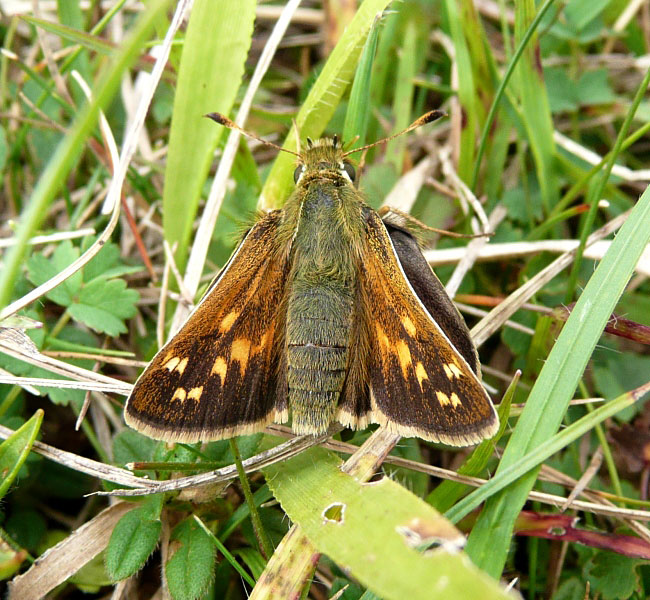
Contrary to the forecast of 24 degrees and sunshine, on arrival Aston Rowant was shrouded in low cloud with occasional drizzle, and was cool with a fair breeze, nevertheless within only a matter of seconds of walking out onto the hillside I found my first target a Silver-spotted Skipper.
In reality the poor weather was probably an advantage in some ways with the Skippers being pretty inactive until disturbed and thus allowed close approach making photography much easier than if they were buzzing around the hillside had the weather actually been hot and sunny.
As usual I took loads of photos, some of which are included below.
As is commonplace in this part of the country, Red Kites were an ever present feature in the sky, but sadly the weather and light made any really decent photos out of the question especially with my point & shoot camera, although I was still happy with what I managed anyway.
Next stop was Yoesden Bank with Adonis Blue the target. As this is the only butterfly to date that I've failed to find on two previous tries, I was determined to succeed this time, and after a couple of false alarms over Common Blues, I disturbed a strikingly coloured Blue from the grass which I instantly knew was going to be one, and sure enough once it settled the upperwing colouration, with more importantly the black lines through the white outer fringe, were quickly confirmed and I was delighted to have seen one at last.
About 3 or 4 Adonis Blues were found, plus a number of other species including several Chalkhill Blues although the males were mostly faded and tatty, but were nice to see nonetheless.
With the predicted sunny and warm weather now materialising, and thanks to some excellent directions given to me by another butterflyer at Yoesden, I quickly made my way to Whitecross Green Wood in search of Brown Hairstreaks.
Brown Hairstreaks have a reputation of being probably the hardest butterfly to connect with, being so unpredictable in their appearances and rarely descending from the canopy of their chosen ash tree. Looking like I was destined to fail, just as I was about to leave I noticed a movement in top of an ash and decided to persevere here just in case. After a few tantalising glimpses during the next hour I finally saw it land in view and a quick check through the bins revealed a gorgeous orange underwing with white lines - it was a Brown Hairstreak! It once again moved and I was then treated to it doing a bit of basking, opening up its wings to reveal the orange patches on its brown wings.
Naturally I was hoping to find one lower down but in reality I was just pleased to see one for now, and to grab a quick digiscoped image of one as it moved slightly lower down into the top of an adjacent tree.
During my earlier searching I also chanced upon a very faded and worn Silver-washed Fritilary which was an added bonus.
All in all an excellent trip with three new species recorded, and excluding vagrants, leaving just 6 more species to see, although given their distance away from Norfolk I'll target them over the next 2 or 3 years and combine them with a bit more dragonflying too.
Tuesday, 9 August 2011
Shags
A look at the sea off Overstrand this afternoon produced a Shag on the sea which was watched slowly drifting east on the tide. After a while it was surprisingly joined by a second and then after a while they both flew off west towards Cromer.
A few Gannets, a couple of Kittiwakes and the odd Guillemot were also noted offshore, along with a couple of Knot, Sanderling and a few Oystercatchers all moving west.
A check up at the reservoir showed that the Common Sandpiper was still present, and a Little Grebe had also taken up residence, the first one I've seen on there this year, and as they frequently do, in the absence of any vegetation to use as cover, it spent most of its time hiding inside the tyres around the edge.
Monday, 8 August 2011
Migrant Hawkers
A walk round Felbrigg Lake today produced the first local Migrant Hawkers of the year with a couple found hanging up in the fairly overcast conditions.
A solitary Black-tailed Skimmer, a Darter sp. and a few Common Blue Damsels were seen, but no sign of any Small Red-eyes on the lake yet. Lots of exuviae were on the walled end of the lake, most of which were Darters, but a few larger ones were collected which presumably were Hawkers.
A Purple Hairstreak was seen feeding on brambles, and a pair of Mute Swans were new in on the lake.
Friday, 5 August 2011
Black Darters and Greenshank
With a warm sunny day in the offing I took a trip over to Dersingham Bog in the hope of finding some Black Darters. Things weren't looking good as after a couple of hours or so I'd just found a number of Common Darters, plus a couple of Emperors and a Black-tailed Skimmer.
Fourtunately a group of birders that I knew then arrived, and with more pairs of eyes looking we saw at least three in the vegetation around the pond.
Also around the pool were good numbers of Emerald Damselflies, my first of the year, which were also nice to see.
I'm not really into Moths, although I did go and see a Deaths Head Hawkmoth at Mundesley a few years back, but the one below did catch my eye as it flew low amongst the heather, and which was identified for me as a Beautiful Yellow Underwing.
On the way back to the car my first Migrant Haker of the year was seen feeding over the heather and briefly hanging up to allow a positive id. to be made.
Returning to the patch early evening I headed straight up to the reservoir as a Greenshank had been seen there in the morning. I wasn't really expecting it to still to be there so I was delighted when a glance round the banks quickly revealed it was, along with a Common Sandpiper.
A quick check of the seafront was rewarded with a Hobby flying east, the shrill alarm calls of the local House Martins alerting me to its presence long before I saw it.
Subscribe to:
Posts (Atom)