Pages

Saturday, 31 March 2012

Merritt Island revisited

Today we paid our second visit to Merritt Island, with after our failure last visit, Scrub-Jay being top of the agenda. A quick visit to the visitor center to check out the feeders incase a Painted Bunting was present drew a blank, but a Gray Catbird was showing well in the car park.


We then moved on to the Pine Flatwoods Trail where the first highlight was this Pileated Woodpecker which gave excellent views on the trackside trees.


Then after more searching we finally found our target when a group of three Florida Scrub-Jays appeared on the track in front of us and showed well on and off as they moved amongst the trees.


A Peregrine was watched drifting over and a Downy Woodpecker was also noted, and finally a Northern Flicker was picked up in flight and then watched briefly as it landed in a distant tree before moving off again. 


We then moved on to the Manatee Observation deck where up to half a dozen were seen loafing in the water, occasionally rising to the surface. A Brown Pelican flew-by, and a Royal Tern was feeding up and down the river.

We then took a drive along Bio Lab Road with new birds for the trip here being Stilt and Least Sandpipers, Black-bellied Plovers, American Wigeon and Laughing Gulls. Other birds of note included Roseate Spoonbill, Mottled Ducks, Black Skimmers and Royal and Caspian Terns. Dowitchers, Yellowlegs, Willets etc were feeding on the pools, along with Blue-winged Teals and Lesser Scaups plus the usual Herons, Egrets and Ibis etc. Although they were seen everywhere you could never tire of seeing Ospreys with this one giving superb close views as it devoured a fish.


We then headed down to Playalinda Beach where a Northern Cardinal was showing well in one of the car parks.


On the beach a couple of American Herring Gulls were loafing on the beach along with Royal Terns, Ring-billed Gulls and Willet.


Laughing Gulls and White Pelicans were drifting along, and on the beach itself Turnstones and Sanderling were also present along with the only Bonapartes Gull of the trip. Offshore Northern Gannets were noted.

Then whilst walking back to the car came the non-avian, and one of the overall highlights of the trip with the discovery of an ultra cute Racoon in the undergrowth below the elevated board walk.


Final highlight of the day was watching this Great Blue Heron catching and devouring a fish.

Leu Gardens and Orlando Wetlands

Most mornings I had seen a dove flying over the house which, despite failing to get more than a fleeting glimpse of, I suspected was a White-winged Dove. Well I was determined to nail it and this morning I finally got my bins on it for a few seconds and indeed confirmed my suspicions, and better still seeing it drop down over the houses, I located it sitting in a tree on the estate where it gave excellent views.


Heading out, first port of call today was Harry P Leu Gardens, which are on the south side of Lake Rowena in NE Orlando, and which act as an urban oasis.

A good selection of birds were seen around the gardens including a Ruby-crowned Kinglet, a female American Redstart, Black and White Warbler, Brown Thrasher, Tufted Titmouse, Blue-headed Vireo, House Wren, Northern Cardinals, Blue Jays and a Downy Woodpecker. On Lake Rowena were a few Wood Ducks, Brown Pelican, Anhinga, Double-crested Cormorant, plus a few Turtles and a pair of Otters were seen to break the surface a few times.

Although called Orlando Wetlands Park, this excellent site is located some way (c30 miles) east of the city, near to the village of Christmas. These freshwater marshes are a haven for wildlife and provided my first sightings of both Marsh Wren and American Purple Gallinule as we walked round. A couple of Vermillion Flycatchers had wintered at the site this year but sadly had departed a week or so ago but checking out the area where they had been just in case, produced my first Common Ground Dove.


As expected the usual waterbirds as encountered elsewhere where present, but new species for the trip included adult and imm Black-crowned Night Herons and 2 American Bitterns. Then whilst watching a Limpkin I noticed a head amongst the reeds and upon getting it in the scope to see what it was I was delighted to see that it was a Least Bittern and we watched as it emerged from the reeds and proceeded to search for food amongst the vegetation.


Other birds of note seen were a few Green Herons, Wood Ducks, Wilsons Snipe, Anhinga, Savannah Sparrows, plus the usual Tricoloured, Little Blue and Great Blue Herons and Snowy, Cattle and American Great White Egrets. White and Glossy Ibis were also present and posed for photos.


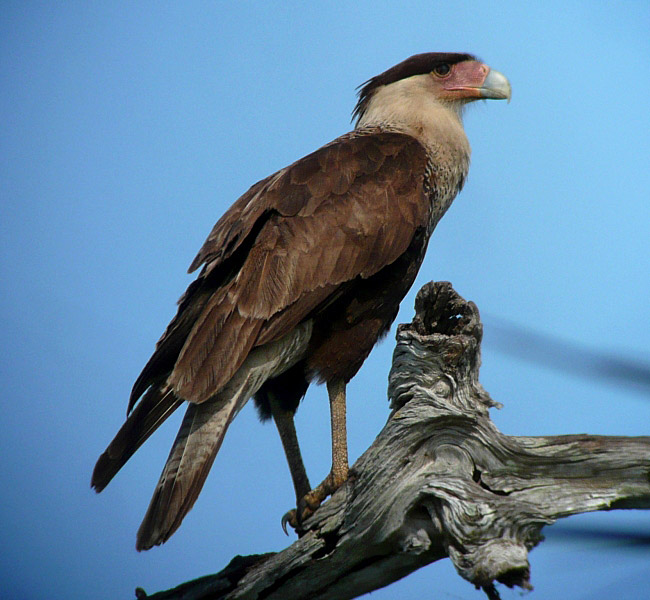
Singing Northern Parula's and Cardinals were present in the trees bordering the lakes, overhead Red-shouldered Hawks, Black and Turkey Vultures, Ospreys, Wood Storks and Anhingas soared around, and this Crested Caracara was perched in the tree tops surveying its surroundings.


As usual Red-winged Blackbirds and Grackles were in the reedbeds, many Blue-winged Teals and a few Shovelers graced the pools, but the star duck of the reserve was a flock of half a dozen Black-bellied Whistling Ducks.


A Swallow-tailed Kite was seen on the journey back towards home, along with a flock of Cedar Waxwings.

Finally a quick evening walk round the trails around the south side of Lake Lizzie produced a Brown-headed Nuthatch and a couple of Wild Turkeys. A Barred/Great Horned Owl was inadvertently flushed but sadly disappeared into the trees before I could get my bins on it which was obviously disappointing, but on a much happier note an Eastern Phoebe was found feeding from trees alongside a stream rounding off an excellent day.


Whooping Cranes and Emeralda Marsh

Bit of a twitch today when the location of a pair of wintering Whooping Cranes filtered through onto the local forum, so off we headed to try and located them in fields a few miles to the north of Lake Apopka. Arriving on site they were immediately located feeding in a bare field, and although they were naturally part of the reintroduction scheme they were still very nice to see. Both were banded and at least one had a transmitter attached to its leg.


With the cranes successfully located in quick time, we decided to head off to Emeralda Marsh which is situated along the north-east side of Lake Griffin. Arriving at the site I was having a quick scan of the bushes around the car park when I noticed a tiny bird alight on a branch of a nearby tree. I assumed it was going to be a wren sp. but on raising my bins I was shocked but elated that it was infact a Ruby-throated Hummingbird!

Whilst it was on my most wanted list I didn't really expect to see one, and certainly didn't expect just to find one like this. It quickly flew off behind the trees and after not appearing again for a while, we went off for a walk along the trail, during which time we saw the first Carolina Wren of the trip, but happily upon our return about an hour later it again reappeared on the very same branch and gave great views, and was undoubtedly one of the major highlights of the trip.


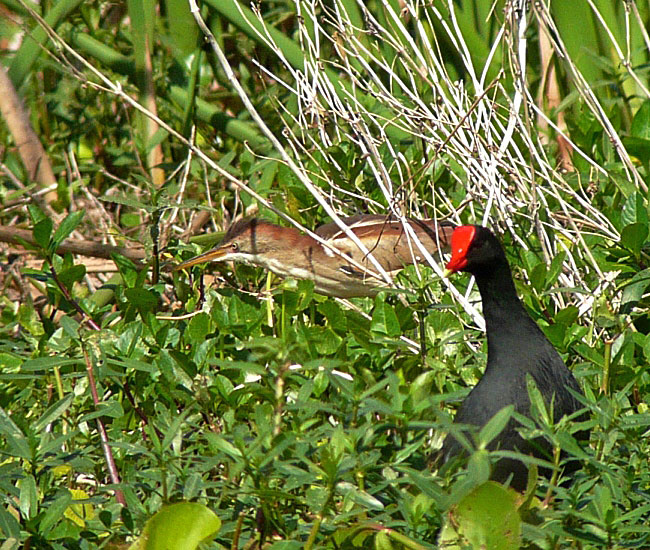
We then drove along the main track towards the marsh seeing an Eastern Phoebe feeding along the trackside stream on the way and then parked up at a marshy pool by a bridge. On the pool I found at least 5 American Purple Gallinules feeding along the edge of the reeds, and whilst most only briefly broke cover, one gave more prolonged views and allowed a few pics to be taken.


A Marsh Wren was seen in the reeds by the bridge, and a Red-winged Blackbird alighted on the overhead wires and gave a great display.


Further into the marsh, two female Ring-necked Ducks, the only ones of the trip, were seen amongst a large group of American Coots, along with a few Blue-winged Teals. Northern Parulas and Cardinals were singing from the trackside trees and Savannah Sparrows skulked in the vegetation. As usual Tricolored, Great and Little Blue Herons, Snowy, Cattle and American Great White Egrets and Glossy and White Ibis graced the marshes. The now daily Swallow-tailed Kite was seen overhead, along with the now familiar Red-shouldered Hawks and Black and Turkey Vultures. A few Northern Harriers were also present over the marshes but none came close enough to get anything more than a record shot like the one below, but it still shows the hooded appearance well.


Later another visit to the south side of East Lake Toho produced Swamp Sparrow, Purple Martins, Limpkin, Purple Gallinule and White-winged Dove along with the resident Snail Kites and all the usual marsh birds.

Kissimmee Prairie Preserve State Park

Today we headed over to Kissimmee Prairie Preserve State Park a 54,000 acre prairie to the south of the Three Lakes Mgt area. Arriving at the car park we were greeted with the sight of this Crested Caracara having a skunk for breakfast!


Eastern Meadowlarks were abundant here, and a few Loggerhead Shrikes, Eastern Towhees, Savannah Sparrows and a couple of pairs of Common Ground Doves were also seen. Northern Parula's, Palm Warblers, Blue-gray Gnatcatchers, Cardinals and Mockingbirds were noted in the Hammock around the visitors centre, where this Wild Turkey was also seen.


The main speciality birdwise of the preserve is the Florida Grasshopper Sparrow and after much searching I eventually heard one briefly sing and then flushed what was presumably it up from the undergrowth. Further searching of the area produced brief flight views of a number of other sparrow sp's flushed up from the grass most of which vanished instantly upon landing, but two Bachman's Sparrows were seen perched up. For anyone visiting the site, these birds were found to the south of the visitors centre in the area of the Kilpatrick Prairie and Kilpatrick Homestead Trails.

White-tailed Deer and Black Racer Snakes were encountered, and the daily sightings of Swallow-tailed Kites continued with a group of three sparring in the air together. A number of Grasshopper sp's were seen during the fortnight with this massive one seen along one of the prairie trails.


Final highlight of the visit was as we were heading out of the preserve along the entrance track we came across a pair of Northern Bobwhites which showed well as they fed in the grass along a mud bank.

Fort Myers Beach

Today was the first of a two day trip over to the Gulf coast with a number of Waders the main target. We headed down to the beaches a few miles south of Fort Myers, with the first port of call being Bunche Beach Preserve on San Carlos Bay. Despite the tide being on the rise and the beach crowded with sunbathers there were a few waders congregated around a bay along the beach to the right of the car park. Semi-palmated Plovers were the predominant species, but I quickly located a couple of Piping Plovers amongst them which showed well unconcerned with our presence.


Western and Least Sandpipers were also present on the waters edge, and on an offshore sandbank were a few Marbled Godwits along with a few American Sandwich (Cabot's) Terns which were mixed in with a roosting flock of Royal and Forsters Terns and Black Skimmers. Brown Pelicans and Reddish Egrets were noted flying along the shore, and an immature Bald Eagle soared overhead.

However with a combination of the tide and walkers pushing the birds across to the other side of the bay and out of viewing range, we cut our losses here and headed off further south to Little Estero Island Critical Wildlife Area which is a series of lagoons at the south east end of the island. As street parking seemed non-existent we parked in the car park of Holiday Inn ($5 for the day) and then headed onto the beach behind and then walked left to the far lagoon.

Again the birds present were incredibly tame and we were treated to superb views of another one of my targets Wilsons Plover.


As with Bunche Beach there were numerous Semi-palmated Plovers, along with a few Piping Plovers and both Western and Least Sandpipers. Dunlin, Sanderlings, Turnstones and Black-bellied Plovers were also present, along with another target species American Oystercatcher.


Laughing Gulls and Royal, Forsters and American Sandwich Terns were also present resting on the lagoons, and Double Crested Cormorants and Brown Pelicans added to the spectacle.


Whilst I was lucky enough to successfully find all but one of the target species, and get excellent views of them in the process, I would definitely recommend anyone considering visiting these sites should do so early morning, and preferably at low tide to maximise their potential. Arriving from mid morning onwards we encountered very heavy traffic, crowded beaches causing disturbance and greatly reducing available feeding areas, and to reach the far lagoon at Little Estero it was necessary to wade through a thigh-high channel due to the tide being in. Its also worth bearing in mind that I understand the lagoons are roped off from April 1st so access and views may be restricted after then.

Sanibel Island

Having spent too much time doing the two beaches, or more realistically stuck in traffic both ways, it was quickly on to our next chosen destination Sanibel Island, and the J N "Ding" Darling National Wildlife Refuge. However my attention was more than distracted when this sailed effortlessly over the car as we drove over the Sanibel Causeway bridge!


Magnificent Frigatebird was, along with RT Hummingbird, top of my list of birds I wanted to see but never expected to, so after a quick emergency stop at the first available parking area, it was simply amazing to watch it as it slowy glided back and forth over the bay, being joined at one stage by a second, and eventually it went right overhead before diving down to the water and stealing food off some gulls and then headed off across the bay.

We then headed to Ding Darling and drove the wildlife drive but, probably due to it being high tide, it was very disappointing and most pools were totally birdless. A few Common Ground Doves feeding along the drive being one of the few bright spots.


After c2 miles round the trail we arrived at the observation tower, and finally some birds, all of which were crowded together on a small area of exposed mud on the edge of the pool. Here I picked out our only Spotted Sandpiper of the trip, complete with a few spots, amongst the more familiar waders, and also new for the trip were a small group of resting Red-breasted Mergansers.

The rest of the 4 mile trail was equally birdless so we quickly made our way to the nearby Bailey Tract reserve with the hope of something better to end the day, and thankfully this small reserve proved very productive.

First bird of note that I found on the pools was the hoped for Black-necked Stilt. It was initially just resting, so whilst waiting for it to do something I glanced round the pool and was delighted to see this American Bittern out in the open.


Also on the pools were American Coots and a few Pied-billed Grebes.


Finally the Black-necked Stilt started feeding and in the process came a bit closer to allow a photo in the fading light.


Finally heading back to the car a Belted Kingfisher was noted, and an American Kestrel was watched perched up on top a bush to end an excellent day.