Pages

Tuesday, 19 July 2011

Southern Hawker

With a bit of sunshine today I had a look for White-letter Hairstreaks at Sidestrand, which like the ones at Holkham were seen coming down to feed on privet, although as they have obviously been out for a while now, all the ones I saw were pretty battered along the wing tips like the one below.


I moved on to Gimingham to check out another WLH site and saw one briefly up in the elms, but the undoubted highlight here was the first Southern Hawker of the year hanging up in the vegetation.


A Brown Hawker was also seen patrolling the area, and 2+ Yellow Wagtails were flying around calling and were presumably local breeders.

Monday, 18 July 2011

Always worth a check

Took a phone call this morning from my Mum to say that whilst she had been walking along Cromer prom an hour or so earlier she had noticed a large dark bird with slightly paler underparts on the sea close inshore which just didn't look right for the Cormorants she was used to seeing along there and made a wild guess that maybe it was a diver sp. and although she is a non-birder she has naturally taken in a bit of knowledge over the years so it was certainly worth following up.

A check of the sea where she had seen it drew a blank, so I decided to look the other side of the pier where I quickly found a Guillemot, and then locked on to her bird which I was delighted to see was a Shag and watched as it slowly drifted back west round the pier back to where she had originally found it, an excellent find and my first July record of one on the patch, and maybe anywhere in the county, with my previous earliest being a few which were around in late August '08.


A further scan of the sea revealed that there were 3 Arctic Skuas, all pale-phase adults, wheeling around high above the horizon slowly heading east, my first of the year, and the tail-end of what was undoubtedly a Little Gull was seen disappearing round the pier.

Sunday, 17 July 2011

Red Kite

Thanks to a phone call this afternoon alerting me to the fact that a Red Kite was over the village and probably heading my way, after a short while I picked it up as it slowly drifted eastwards virtually overhead. As it reached the far end of the village it started to circle and quickly back-tracked to where I was and then landed in a nearby tree. With the almost immediate onset of showers it was obviously sheltering from the elements and so would hopefully allow me enough time to dash home to grab my scope in order to try to get a photo. On my return I was delighted that it was still there and I alerted a few locals to its presence and soon a small but very appreciative group assembled to enjoy rare perched views as it continued to shelter until the showers temporarily subsided and it eventually flew off low west.


Friday, 15 July 2011

Brown Hawker

For a slight change of scenery when visiting Felbrigg Park this week, I've spent a bit of time over a couple of days around the small pond towards the western entrance, with the area proving very productive.

On the bird front 25+ Crossbills were noted flying over heading towards the Lions Mouth, Butterflies included both White Admiral and Purple Hairstreak and Dragonflies were well represented by Ruddy Darter, Banded Demoiselle, 2+ Emperors including an ovipositing female and a pair of Broad-bodied Chasers with the female also noted ovipositing, however the main highlight was a couple of Brown Hawkers with after a lot of waiting one finally perching on the bankside vegetation to allow me to get my best photos to date of the species.


Down by the main lake the Purple Hairstreaks continued to be as non-obliging photography-wise as ever although good numbers continue to be present in the 'master' tree, the White Admiral was still present and good numbers of Gatekeepers were now evident in the meadows. On the lake itself a Green Sandpiper was happily feeding along the eastern shoreline, Black-tailed Skimmers, Emperors and Common Darters were all noted and more exuviae were found along the wall to add to my growing collection.

Tuesday, 5 July 2011

Willow Emeralds

With news that Willow Emerald Damselflies had begun to emerge, I took a trip down to Alton Water, where I had briefly seen them last year. Shortly after arrival I quickly located one not far from the car park and then over the next couple of hours found another 10 or so in the lakeside vegetation. Most were fairly fresh tenerals but I did manage to find a couple of slightly more mature ones, and managed to get a few decent photos with some reproduced below.


My first Brown Hawker and Ruddy Darters of the year were also seen, with a photo of one of the latter plus a Red Admiral below.


Monday, 4 July 2011

Felbrigg

The highlight of a walk round Felbrigg yesterday was my first White Admiral there, with one seen briefly by the bridge on the west side of the lake.


A Hummingbird Hawkmoth was also seen along with a few Purple Hairstreaks but none came close enough to allow a photo.

Another visit today again failed to get any decent photos of them as again they refused to come low enough down, but I did manage the photos below of a Small Copper and Black-tailed Skimmer.


Saturday, 2 July 2011

Heath Fritillary

Had a day out today with Heath Fritillary, which would be a new species for me, the target species. I arrived at Belfairs Wood at c8.30 in lovely warm and sunny weather and quickly found White Admiral and a Silver-washed Fritillary, the latter, looking at the county website, potentially a first site record, so things were looking good. However very quickly it clouded over and the stubborn dark clouds which seemed to be only present over the wood, it was lovely blue sky in all directions, refused to move off and three hours later without success I decided to cut my losses and move on to nearby Hockley Woods to see if my luck would improve.

After about some 45 minutes of searching there, the clouds eventually started to break up and the sun started to warm things up and consequently the butterflies in the wood started to become active. However apart from a very brief flight view of a possible Heath Frit I still drew a blank and started to wonder if I'd just left it too late in their flight season and they were over for this year.

After about a further hour of searching in glorious sunshine, I decided to go back to Belfairs for one last try, with fortunately the warm and sunny weather continuing. Another hour was spent searching, with further sightings of the Silver-washed Fritillary and White Admirals, but still no Heath Fritillaries.

Just before giving up, it was now 16.30, I made one final sweep across the other side of the reserve in Dodds Grove and suddenly flushed an unfamiliar butterfly up from vegetation and I froze as it flew across the clearing, willing it to settle as it went. Knowing that it wasn't any of the common species I was happy that it was one but I wanted to see it perched and thankfully it duely obliged by landing on the far side of the clearing. A quick check through the bins confirmed it was indeed a Heath Fritillary and I managed to take a distant record shot of it before it took flight again but disappointly refused to settle again and disappeared off up into the trees and despite more searching was never relocated.

However after 8 hours of searching during which time I had given up all hope of connecting, I was more than delighted with just the brief view and another new species of butterfly.

Thursday, 30 June 2011

Green Sand and Quail

Another visit to Felbrigg today produced the first Purple Hairstreak of the year with one in the oaks on the east side of the lake. Checking the wall I found a few more exuvia and a few teneral Common Darters were flushed from the lakeside vegetation as I walked round.

Good numbers of butterflies were evident in the meadow to the south of the lake including Small Coppers, Common Blue, Large & Small Skippers, Meadow Browns, Ringlets and Green-veined Whites.

Walking round to the north end of the lake I heard a familiar call and swinging round I picked up a Green Sandpiper, my first of the year, flying in over the lake. It briefly pitched down in the stream but as a party of school children were then walking along the adjacent boardwalk, they quickly flushed it and it flew off high to the west.

Checking the brambles near the boardwalk I found my first Gatekeeper of the year which briefly paused to feed before flying off across the meadow.


Also in the same area a Black-tailed Skimmer and a rufescens form Blue-tailed Damselfly posed for photos too.


A trip to West Runton late afternoon was rewarded with a Quail calling away from the weedy field by the farm buildings, and then after a Hobby flew low west over the field causing it to go silent for a while it eventually sang again from the adjacent barley field.

Todays two year ticks brought the patch year list up to a very respectable 153 species for the first six months of the year, and given that I had recorded just 3 more by this point last year, maybe beating 2010's record total is achievable with a very good autumn, tho I think I'd settle for finding a patch first instead.

Wednesday, 29 June 2011

Common Darters emerging at Felbrigg

A visit to Felbrigg Park today revealed that a few Common Darters were emerging from the lake, with a number of tenerals seen taking their maiden flights, a number of spent exuvia found along the walled end of the lake, and the one below which was found having just emerged from its exuvia and then watched as its wings fully formed before flying off into the vegetation in the meadow.


The first Emperors I've seen there this year were patrolling the lake, along with a few Black-tailed Skimmers, and a few Broad-bodied Chasers, such as the one below, were patrolling the adjacent meadow and hedges.


Bird-wise the resident Little Owl was seen perched up on its usual tree surveying its surroundings.

Thursday, 23 June 2011

Garden Birds

Its been nice to see a good number of juvenile birds feeding in the garden recently, and in addition to the more regular species, a pair of Great Spotted Woodpeckers that have been regularly visiting the feeders over the last few weeks have now brought in at least 2 juvs with them, and today for the first time ever a couple of Nuthatches also visited the feeders.

Monday, 20 June 2011

White-letter Hairstreaks and Dark Green Fritillaries

With the nice sunny and warm weather a trip was made to Holkham today to see what butterflies were performing.

A White Admiral was seen along the track along from Lady Annes Drive, and then arriving at the bench just before Washington Hide a White-letter Hairstreak was immediately located on the flowering privet there. A number of others were seen flying round the tops of the elms opposite with the occasional one also coming down onto the privet, but frustratingly they would always land just too far away to get a decent pic, however one eventually gave itself up and landed in an accessible area to get a nice close-up of it.


Small Skipper, Comma, Red Admiral and Meadow Browns were also feeding from the same bushes as was a Hummingbird Hawkmoth. A Spoonbill flew across the freshmarsh, 3 Crossbills flew over the pines calling, a Hawker Dragonfly sp. was seen briefly around the treetops, and an even briefer flypast of what was probably a Broad-bordered Bee Hawkmoth all added to the abundance of life there.

A walk further along to the dunes revealed good numbers of Dark Green Fritillaries were present and with careful and patient stalking I finally secured a few pictures with a couple reproduced below.

Friday, 17 June 2011

First Ringlet and Meadow Browns

A walk round East and West Runton today failed to relocate yesterdays (fly-through) Roller, but an adult Med Gull flew south over Incleborough Hill and in the meadows to the north were the first Meadow Browns that I'd seen on the patch this year and the first Ringlet of the year too.

Thursday, 16 June 2011

WHITE-WINGED SCOTER

Today saw the second twitch of the month, this time with me heading up to hopefully see the White-winged Scoter which had been found at Blackdog at the weekend.

Arriving at the beach a few small Scoter flocks were noted offshore along with numerous Eiders roosting on the shore but a scan of the sea revealed that the main seaduck flock was much further south, some c2miles off in the distance. So off we set along the beach, periodically stopping to scan the sea whenever any Scoter or Eider were seen passing.

As we neared the main flock the pager announced it was still present, but as there had been no other cars in the car park and no sign of any birders along the beach or dunes we were intially puzzled by the message but nevertheless started to scan through the nearest flock of birds. In the meantime after a couple of phone calls we located the other observers who had previously been watching it, and then again embarked on the search from their higher vantage point in the dunes.

With the sun now gaining strength there was an immense glare off the sea which along with the heat haze made the task of relocating it quickly a long shot, but I began a meticulous search through the gathering of some 1500+ Eider and Scoter, with the later being the more distant.

The glare and haze continued to hamper the search for the next half hour or so but with a brief cloudy interlude visibility vastly improved and I embarked on yet another sweep of the flock focusing this time on the area just behind the Eider flock that a few Scoter had drifted into. All of a sudden I locked on to it with the head & bill shape along with the pale grey band on the tip of its dark bill immediately obvious and accordingly quickly made everyone else aware that I'd got it. Typically it quickly dived but having gotten everyone onto the area where it was, when I again picked it up as it resurfaced most of the assembled crowd got on to it before it drifted further back into the main scoter flock where it was lost to view amongst the throng of the other birds as the glare and haze returned.

For the next hour or so the sun beat down on the sea making viewing virtually impossible, and we continued to search for it and the Surf Scoters which were also present in the flock with no luck. Eventually it again clouded over and it was amazing the difference it made with the Velvet Scoters, both male and female, now easy to pick out and soon after the White-winged was again relocated amongst a small group of Velvets and was on show for a few minutes before the group all dived but despite all the Velvets resurfacing one-by-one, there was amazingly no further sign of the White-winged showing how elusive it could be.

Our attentions were then temporarily distracted by one of the Surf Scoters appearing briefly in the flock, and then a little while later I again picked out the White-winged amongst some Velvets and this time we were all able to watch it for a good while as it drifted along and watched as it became more active preening and diving before it was again lost to view amongst the other birds. It even came vaguely near enough for a few record shots to be obtained, with the one below showing it behind a small flock of Velvet and Common Scoter.


The tide was now coming in fast and as a consequence the flock drifted in closer, and with more and more cloud cover viewing was getting better by the minute and we again relocated one of the Surf Scoters which this time was watched for a good time with the record shot of it below being obtained.


With viewing conditions now being the best they had been all day with no haze and the flock coming ever closer, it was great to again relocate the White-winged along the back of the Eider flock, the closest it had been all day and thus giving its best views. Despite it still being very distant photography wise I did manage to get the photo below which is fairly decent, and shows well the shape of the head and bill, and even the fact that you could see through its nostrils (although this was only noticed in the photo after rather than in the field at the time), and also for the first time the white in the wing was also noted.
  

With us all being happy with the views, plus seeing a nice selection of other birds which in addition to the Surf and Velvets Scoters, included Red-throated Divers, Razorbills and Guillemots, and a few photos of the White-winged in the bag too, we embarked on the long walk back to the car delighted with a new bird.

Wednesday, 15 June 2011

Bluethroat at West Runton

With a Bluethroat having been found down the beach road at West Runton this morning, spent a few frustrating hours there not seeing it although a fly-over Hobby and a late Wheatear provided some distraction during the searching. Thankfully it was eventually found sitting motionless amongst the vegetation along the field edge just south of the shelter and then subsequently as it ran across the 'new' field occasionally pausing amongst the weeds before disappearing into the adjacent cereal field.

An excellent bird, and a new bird for the patch for me (WR wasn't part of my patch when the one was by the farm buildings a few years back) so a very welcome late spring record. Didn't manage a photo though as it moved too fast across the field and having spent c5 hours down there and needing to be elsewhere (i.e Mucar GC for the W.W Scoter) I reluctantly dragged myself away happy with just having finally caught up with it.

Tuesday, 14 June 2011

Silver-studded Blues

With the nice weather today I visited Kelling Heath to look for Silver-studded Blues and wasn't disappointed with around a dozen showing well just over the railway crossing.


A good number of Crossbills were flying round, particularly favouring the pine trees on the edge of the garden of the house by the crossing. The biggest flock I counted was of 25 birds but quite a few smaller flocks were also seen so there's obviously a healthy population up there at present. Other birds noted included a Turtle Dove purring away, a Common Buzzard hovering high up in the sky and the usual Stonechats. 

Thursday, 9 June 2011

White-throated Robin revisited and a few Butterflies too

With the White-throated Robin unexpectedly hanging around, a return trip was made today with my Dad, with the added aim of hopefully getting some photos of it and depending on time and weather doing some butterflying too.

Shortly after arrival at c8:45 it was watched feeding in the borders within the inner bowling green but was still evading my photographic efforts but after a while it flew off over the road and was quickly refound feeding out in the open on the seaward side of the outer bowling green where it gave crippling views for over 15 minutes allowing me to finally get some pics of this absolutely stunning bird and a true Mega.


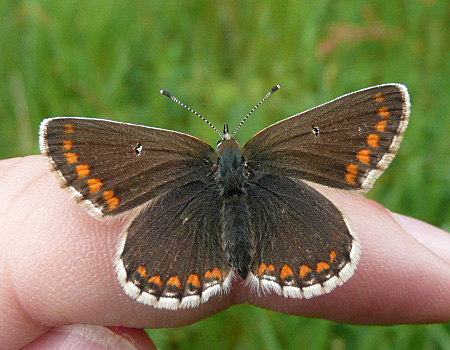
With the bird safely and quickly in the bag with good photos to boot, we quickly moved on to make full use of the sunny weather that was gracing the north-east. First stop was Bishop Middleham quarry, most famous for its breeding Bee-Eaters in 2002, but also as one of the most southerly sites for Northern Brown Argus with half a dozen or so quickly found including some really good looking individuals which seemingly closely resembled the scottish populations more than the more weakly marked nothern england subspecies 'salmacis', which was good as 'normal' Brown Argus are now being found this north so there was no question over their id.


Note the white spot in the centre of the forewing on the upperside, and on the underwing the much reduced or absent black spots within the white blobs which separate this species from the Brown Argus.

Also seen in the quarry were Small Heath, a pair of Wall in copulation and Large Skipper.


 It was then on to Fen Bog on the North York Moors, and although there were still good sunny periods there was a very blustery wind meaning anything that was present was keeping low and out of site and after a couple of hours of searching we only had a Painted Lady and a Wood Tiger Moth for all our effort.


On the way back and not far from the car park my Dad finally stumbled upon our first target species a Small Pearl Bordered Fritillary. However due to the wind it was tucked low down in the vegetation making a photo very difficult but I managed a quick record shot before it took flight and was swept away in the wind out of sight and couldn't be relocated.


Shortly after and whilst searching the area for more I chanced upon our other target a Large Heath and again although it was keeping low down I got a more acceptable image of this one before it flew off across the bog to a more sheltered area where a few more were present but none settled in sight.


Both Keeled Skimmer and Broad-bodied Chaser were briefly seen and on the bird front male Redstart and Whinchat were seen on the moor and a Peregrine was seen overhead with prey. So a really excellent day in the end with superb views of the White-throated Robin plus 3 new species of Butterfly so we returned home very happy.